If you've spent any time researching how to grow better crops lately, you've probably run into the word "bio-stimulant" more than once, usually next to a bottle promising stronger roots, better yields, or healthier soil. It's also, admittedly, one of those words that can sound like pure marketing until you actually break down what it means.
So here's the simple version.
A bio-stimulant, in plain terms
A bio-stimulant is a substance or microorganism applied to a plant or its soil that improves how the plant grows, absorbs nutrients, and handles stress, without functioning as a fertilizer itself. That last part is the key distinction. A bio-stimulant doesn't supply nitrogen, phosphorus, or potassium the way a fertilizer does. Instead, it works more like a set of instructions, nudging the plant's own biology to perform better with what it already has access to.
This isn't just a marketing framing either. Under the EU's Fertilizing Products Regulation, the definition the European Bio-stimulants Industry Council helped establish is that a plant bio-stimulant stimulates plant nutrition processes independently of the product's actual nutrient content, aiming to improve nutrient use efficiency, stress tolerance, crop quality, or the availability of nutrients already present in the soil. In other words, it's officially defined by what it does, not by any single ingredient it contains.
Think of it this way: fertilizer feeds the plant. A bio-stimulant helps the plant use that food, and everything else around it, more effectively.
Wait, is amino acid a bio-stimulant? What about seaweed extract?
Yes, and yes. Which is usually where the confusion starts, because "bio-stimulant" is a category, closer to how "vitamin" covers a whole range of different compounds that each do something different in the body.
None of them are the same substance, and none of them work the same way, but they all fall under the same umbrella because they all share one thing in common: they support the plant's biological processes rather than feeding it directly.
So what's actually inside a bio-stimulant, specifically?
This is where it gets interesting. Plenty of products on the market are built around just one of these ingredients.
You'll find bio-stimulants that are purely amino acid-based. Others are just seaweed extract, or just humic acid, or a standalone microbial inoculant. All of these are legitimate bio-stimulants, and for a specific, narrow problem, a single-ingredient product can genuinely work well. Seaweed extract has strong supporting research. A recent meta-analysis of worldwide studies shows seaweed extract-based bio-stimulants increased yield and biomass by about 16%. Stronger gains appear in tropical and arid areas where abiotic stress is common, matching Indonesian farming conditions.
But here's the catch: a plant's struggles rarely come from just one gap. Weak roots, poor nutrient uptake, and low stress tolerance often show up together, not one at a time. An amino acid-only product supports metabolism, but it isn't doing much for root architecture. A seaweed-only extract nudges growth and resilience, but it isn't actively unlocking nutrients already locked up in the soil. Each ingredient does its job well, on its own, it's just solving one part of a bigger picture.
Bio-stimulant, bio-fertilizer, or bio-pesticide? These aren't the same thing
Many people are confused here. These three terms are often used interchangeably, even though they shouldn't be. Value them correctly to avoid misinterpretation.
A bio-fertilizer contains living microorganisms that actively supply or unlock nutrients for the plant, think nitrogen-fixing bacteria or phosphate-soliloquizing microbes. Its main job is nutrition.
A bio-pesticide uses natural organisms or compounds to control pests, pathogens, or weeds. Its main job is defense.
A bio-stimulant does neither of those directly. Its job is to improve the plant's performance. It enhances root growth and nutrient efficiency. It increases stress tolerance without supplying nutrients or acting as pest control. Some formulations blur these lines a little (a good microbial mix can support more than one function at once), but the core distinction holds: a bio-stimulant works on the plant's biology, not on the nutrient supply or the pest problem directly.
So, do you actually need one?
Here's the honest answer: it depends on what problem you're trying to solve.
If your soil is severely nutrient-deficient, a bio-stimulant alone won't fix that, you still need proper fertilization. If you have an active pest infestation, you need pest management, not a bio-stimulant.
But if your plants are getting fed and watered and still under-performing, weak root systems, inconsistent growth, poor resilience during dry spells or heat stress, that's exactly the gap a bio-stimulant is built to close. Research on seaweed-derived bio-stimulants specifically points to enhanced root growth and nutrient uptake that allows crops to make better use of soil resources already available to them, potentially reducing how dependent a farmer needs to be on synthetic fertilizer (ijcmas.com). It's also useful as a way to reduce how much chemical fertilizer you actually need, since a plant that absorbs nutrients more efficiently doesn't need as much fed to it in the first place.
For most working farms and gardens, especially ones dealing with degraded soil after years of heavy chemical input, a bio-stimulant isn't a luxury add-on. It's closer to giving the soil back some of the biological tools it's lost over time.
Farmer's right hand, also your right choice.
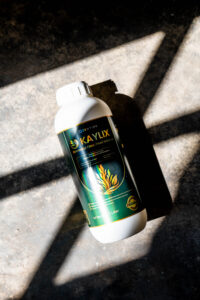
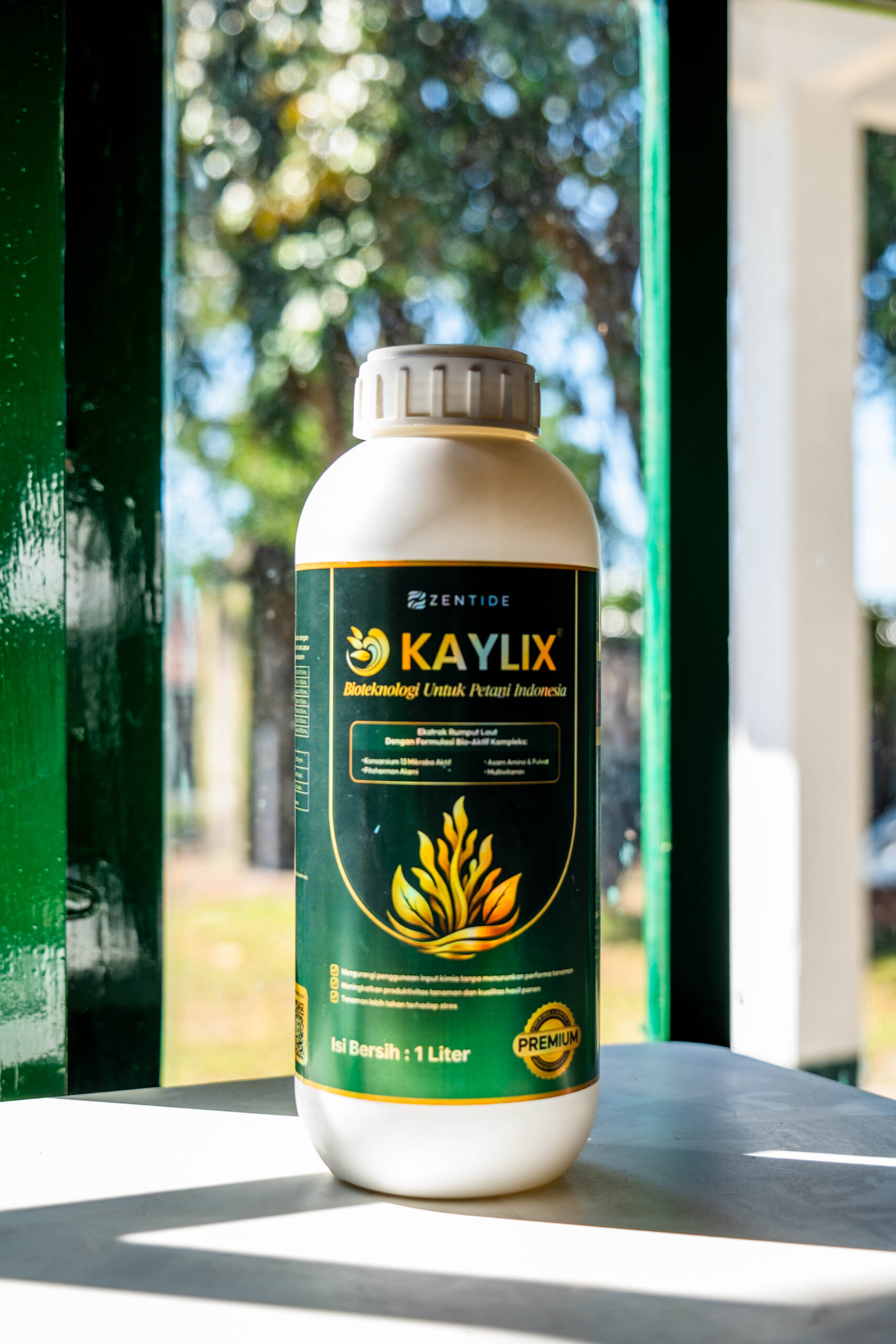
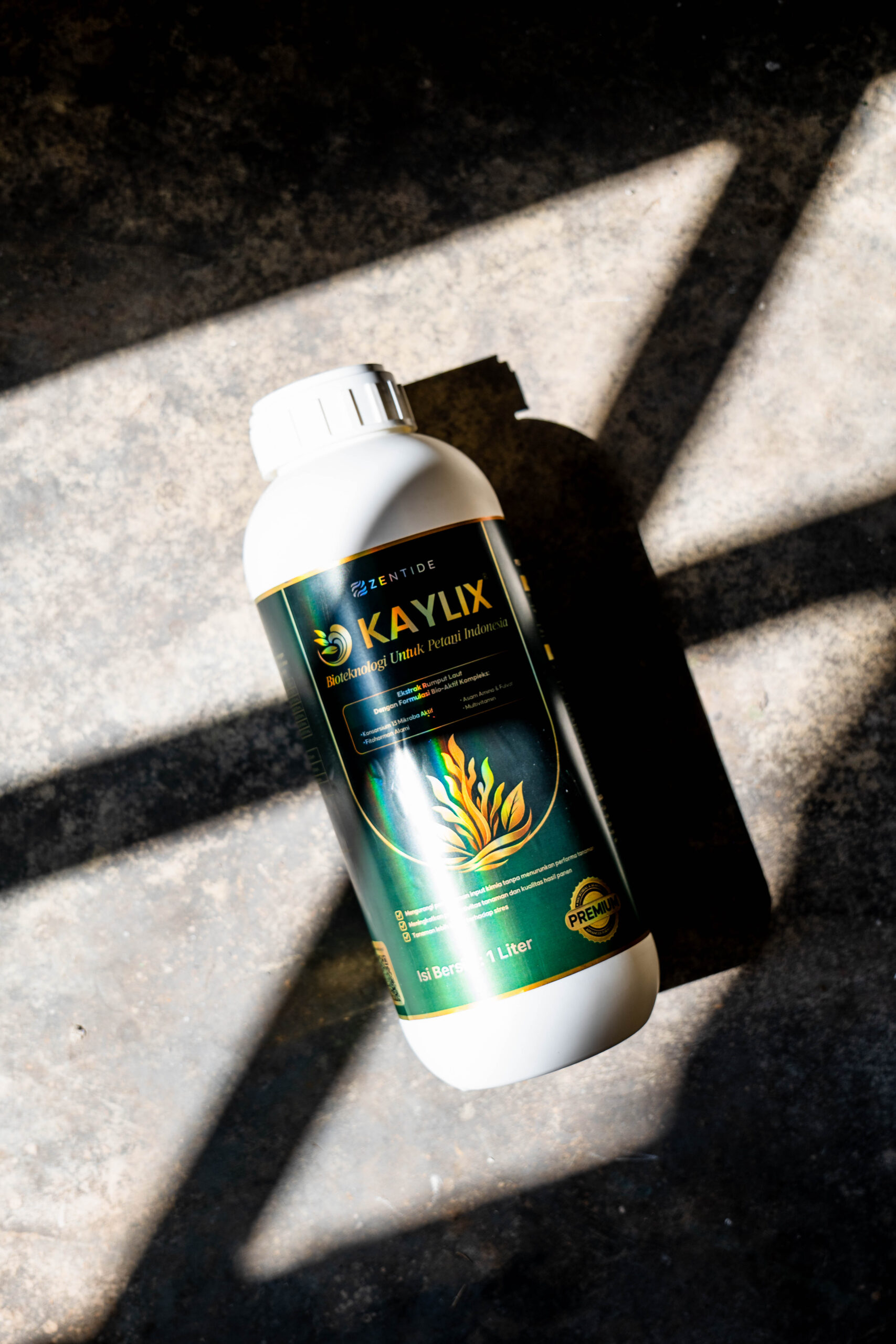
This is really the whole idea behind Kaylix. Instead of picking one lane, seaweed extract, or amino acids, or microbes, it's formulated as all of them working together: tropical seaweed extract, a precision blend of 14 active microbes, organic acids, and natural phytohormones, in a single bottle.
Seaweed extract, check. Amino acids, check. Beneficial microbes, check. Natural phytohormones, check. Rather than being one piece of the bio-stimulant puzzle, Kaylix is built to be the whole system, so a farmer isn't left wondering which single ingredient to buy, or worse, buying three different products to cover what one well-formulated one already could.
In practice, that means Kaylix works on all three fronts a bio-stimulant is supposed to cover: seaweed compounds and phytohormones support root development and stress tolerance, the microbial blend helps unlock nutrients already present in the soil, and the combination allows a plant to make better use of whatever fertilizer is already being applied, often meaning less fertilizer is needed for the same or better results.
It's not a replacement for fertilizer, and it's not a pesticide. But the missing piece for farmers who are already doing the basics right, watering, feeding, protecting their crops, but still watching plants struggle to reach their full potential.
If that sounds like where you're at, that's your answer to "do I need a bio-stimulant." And Kaylix is one built specifically for Indonesian growing conditions, tested across more than 150 field trials and 40-plus crops (Zentide internal field trial data, 2025–2026).